A large cavity, broken cusp, or darkened tooth does not by itself prove that root canal treatment is necessary. The decision depends on whether the pulp is irreversibly inflamed or dead, whether the tooth can be restored, and what clinical tests reveal about cracks, infection, and surrounding bone.
Key takeaways
- Deep decay, cracks, and dental injuries can expose or infect the pulp.
- Lingering hot or cold pain, swelling, and chewing pain need dental assessment.
- X-rays, pulp tests, and examination determine whether root canal treatment is suitable.
- A final filling or crown seals and strengthens the treated tooth.
Which types of damage can reach the tooth’s pulp?
Root canal treatment becomes relevant when damage reaches the dental pulp, the blood- and nerve-containing tissue at the centre of the tooth. Deep tooth decay can travel through enamel and dentine into the pulp, while a crack can open a pathway for bacteria or repeatedly irritate the pulp during biting.
Repeated dental procedures, such as several fillings or extensive tooth preparation for a crown, can also leave the pulp inflamed. A traumatic injury can damage it even when the crown looks intact.
A large cavity or broken tooth does not automatically require root canal treatment. A cracked tooth causes root canal treatment only when the crack has affected the pulp; treatment cannot reunite the cracked tooth or correct an unrestorable fracture.
| Pulp condition | Typical response | What it indicates |
|---|---|---|
| Reversible sensitivity | Brief sharp pain to cold or sweet foods that stops within seconds | The pulp may recover after decay or a faulty filling is treated |
| Irreversible pulpitis | Spontaneous throbbing, or hot and cold pain that lingers for 30 seconds or longer | The inflamed pulp is unlikely to heal; root canal treatment may be needed |
| Pulp necrosis | Little or no response to temperature, sometimes with darkening, swelling, or a gum boil | The pulp has died and infection can develop |
Pain that suddenly stops does not prove recovery; it can signal pulp necrosis. A dentist must also assess whether the tooth has enough sound structure and support to restore.
Which symptoms suggest irreversible pulp damage or infection?
A brief twinge that stops within a few seconds after cold or sweets often fits reversible sensitivity. Lingering hot and cold pain points to inflamed pulp that may no longer recover, especially when the pain continues for 30 seconds or longer after the trigger is removed.
Look for these warning signs:
- Spontaneous throbbing tooth pain that starts without eating or drinking
- Pain when biting or releasing the bite
- Pain that wakes you or worsens when you lie down
- A darkening tooth after an injury
- Facial swelling and gum boil, or a pimple that repeatedly drains near the tooth
- Fever, tenderness, difficulty opening your mouth, swallowing, or breathing
| Symptom pattern | What it can mean | What to do |
|---|---|---|
| Brief cold sensitivity | Reversible irritation or exposed dentine | Arrange an examination if it persists |
| Lingering heat or cold pain | Irreversible pulpitis | Seek dental assessment promptly |
| Severe pain that suddenly stops | Pulp necrosis; the nerve may have died | Do not assume the tooth has healed |
| Swelling or a draining gum boil | Infection from a dead or infected pulp | Arrange urgent dental care |
Pain disappearing can be the dangerous turning point: dead pulp no longer sends strong signals, while bacteria continue spreading through the root. A draining gum boil can reduce pressure without eliminating infection. Rapidly increasing swelling, fever, or trouble swallowing or breathing requires urgent medical or dental assessment.
How does a dentist determine whether root canal treatment is needed?
A dentist combines your history with clinical tests rather than relying on one symptom or one cold response. The dental examination checks decay, broken cusps, swelling, gum drainage, colour changes, tenderness, cracks and how much sound tooth remains for a restoration.
- A pulp sensibility test uses cold, heat or an electric stimulus. A lingering or absent response can support an inflamed or dead pulp, but the test measures nerve response, not blood supply, and nearby teeth provide comparison.
- A percussion test for tooth pain taps the tooth; pain suggests inflammation around the root, but it does not prove that the pulp is infected.
- A bite test applies pressure to individual cusps. Sharp, localised pain raises suspicion of a crack, yet it cannot show the crack’s depth or confirm that the tooth is restorable.
- Periodontal probing measures pocket depth around every surface. One narrow, deep pocket can point to a crack or root fracture, but probing alone cannot diagnose either.
- An angled dental X-ray for root canal shows decay, root shape, bone loss and some infections. Different angles can reveal a hidden lesion, but early pulp disease and many cracks leave no visible X-ray trace.
The dentist then decides whether the tooth can be sealed and restored. Root canal treatment addresses diseased pulp, not a vertical root fracture, an unrestorable crack, inadequate bone support or insufficient remaining tooth structure. A large cavity alone does not prove that treatment is needed.
What happens during treatment and why does the tooth need a final restoration?
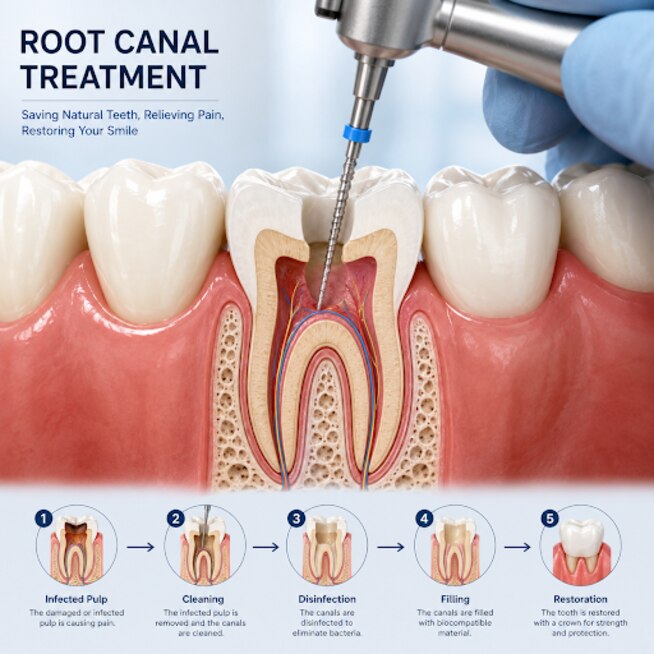
Local anaesthetic numbs the tooth and surrounding gum. A rubber dam root canal isolates the tooth from saliva and bacteria while helping prevent you from swallowing or inhaling instruments or irrigants. The dentist makes an access opening, removes the inflamed or infected pulp, and locates each canal.
The root canal treatment steps then include:
- Cleaning and shaping the canals with fine instruments, removing diseased tissue and creating space for the filling.
- Irrigating the canals with disinfecting solution to flush out debris and reduce bacteria.
- Drying the canals, filling them with a material such as gutta-percha, and sealing the access opening.
The seal placed at the appointment is not always the finished restoration.
| Type | Purpose | Limitation |
|---|---|---|
| Temporary filling after root canal | Closes the access opening while the tooth settles or awaits restoration | Can wear, leak, or fall out if left too long |
| Definitive restoration | Rebuilds the tooth and provides a durable coronal seal | Requires enough sound tooth structure to retain it |
| Crown after root canal | Covers and protects a weakened tooth, especially a back tooth | Cannot save a tooth with an unrestorable crack or vertical root fracture |
A root-filled tooth has lost internal tissue and often substantial outer structure, so biting forces can split it even after infection is removed. Arrange the definitive filling, onlay, or crown promptly; leakage through a damaged temporary seal can allow bacteria back into the canals.
When does the tooth’s age, injury, or structural damage change the plan?
A tooth can look broken yet keep a healthy, recoverable pulp. If deep decay leaves the pulp vital and bleeding can be controlled, vital pulp therapy—such as a partial or full pulpotomy—may preserve it instead of immediate root canal treatment. A predictable seal and enough sound tooth structure are essential.
Trauma changes the timing, not just the treatment. A root canal after dental trauma may be needed when the pulp later dies, even if the crown initially looks intact; an immature permanent tooth needs follow-up X-rays because treatment may aim to preserve continued root development. Ask:
- Is the pulp vital, irreversibly inflamed, or necrotic?
- Can vital pulp therapy preserve root development?
- Is enough tooth left to support a filling, crown, or cuspal-coverage restoration?
- Does the tooth have adequate periodontal support?
- If this is a baby tooth, how long must it remain and how is its developing successor positioned?
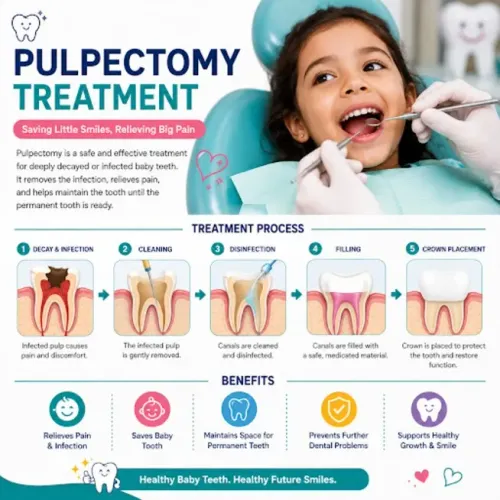
For a baby tooth, pulpectomy for baby teeth is considered when infected pulp cannot recover and the tooth remains restorable; extraction is preferable when infection cannot be controlled or too little time remains before normal shedding. A vertical root fracture treatment plan commonly involves extraction because a root canal cannot reunite the split.
Severe bone loss, an unrestorable crack, or inadequate structure can lead to extraction even after infection is treated. Dr Rohini Lahane can use examination, pulp tests, probing, and radiographs to compare these options before committing to treatment.
Related service
Adult Dental Care (RCT) by Dr. Rohini Lahane in Hadapsar, Pune Dr. Rohini Lahane (BDS, MDS) offers advanced Root Canal Treatment (RCT) to save infected or severely... View service → |
Frequently asked questions
Which types of damage can reach the tooth’s pulp?
Deep decay can pass through enamel and dentine into the pulp. Cracks, fractures, repeated dental procedures, and traumatic injuries can also expose or irritate it.
Which symptoms suggest irreversible pulp damage or infection?
Lingering pain after hot or cold drinks, spontaneous toothache, pain when biting, swelling, a gum pimple, tenderness, or darkening of the tooth can signal serious pulp damage or infection.
How does a dentist determine whether root canal treatment is needed?
The dentist reviews your symptoms, examines the tooth, tests its response to cold or heat, checks for biting tenderness, and uses dental X-rays to assess the roots and surrounding bone.
What happens during root canal treatment, and why is a final restoration needed?
The dentist removes inflamed or infected pulp, cleans and shapes the canals, fills and seals them, then restores the tooth. A filling or crown prevents leakage and helps protect the weakened tooth from fracture.
When can age, injury, or structural damage change the treatment plan?
Young teeth with incomplete root development may need procedures that preserve or support continued root formation. Severe fractures, insufficient remaining tooth structure, or extensive injury can require a different restoration or extraction.