Losing a baby tooth months or years before its successor is ready can change how nearby teeth erupt, but not every early loss requires an appliance. You will learn which teeth and timing patterns create the greatest risk, how a dentist assesses that risk, and what treatment and day-to-day care involve.
Key takeaways
- Early loss of a second baby molar can let the first permanent molar drift forward.
- Dentists assess the child’s age, tooth position, eruption timing, and available space.
- Fixed and removable appliances suit different teeth, eruption stages, and children.
- Avoid sticky foods, clean around the appliance, and attend scheduled checks.
Which early baby-tooth losses are most likely to threaten space?
Premature loss of a primary molar is the early baby-tooth loss most likely to threaten space, especially loss of a second molar before the first permanent molar erupts. The back teeth preserve arch length and guide the incoming permanent teeth; nearby teeth can tip or drift into the gap, changing the eruption path and bite.
| Loss pattern | Space risk | Main concern |
|---|---|---|
| Second primary molar lost before the first permanent molar erupts | High | The first permanent molar can move forward and reduce space for its successor |
| Primary molar lost after the first permanent molar is established | Variable | Adjacent teeth may drift or tip, depending on the child’s age and crowding |
| Primary incisor lost early | Usually lower | Anterior space is less likely to collapse significantly, but midline, speech, appearance, and bite can change |
A primary tooth lost through decay, infection, trauma, or extraction is different from normal shedding at its expected age. Baby teeth guide permanent teeth, support chewing and speech, contribute to appearance, and hold arch length until successors erupt. Primary incisor loss and space maintainer treatment therefore require individual assessment rather than an automatic appliance.
The extraction date alone cannot predict the result. The dentist considers the tooth’s identity, the child’s age, the date of loss, the successor tooth’s development and position, existing crowding, the bite, and whether adjacent teeth can drift.
Early loss can cause tipping, midline changes, altered eruption paths, or bite changes, but it does not automatically require a space maintainer. A clinical examination and dental X-ray may be needed.
How does a dentist decide whether a space maintainer is needed?
A dentist recommends an appliance only after a space maintainer assessment, not simply because a baby tooth is missing. The dentist records the cause and date of loss, examines the bite and adjacent teeth, checks existing crowding, and confirms whether the first permanent molar has established its position.
Oral hygiene, caries risk, and the child’s ability to keep an appliance clean also matter.
A dental X-ray for premature tooth loss shows the permanent successor’s position, root development, eruption stage, and distance from the mouth. Those findings help estimate permanent successor eruption and whether the gap must remain open.
Maintenance may be unnecessary or unsuitable when:
- The permanent successor is close to eruption.
- The space has already closed through drifting.
- The permanent successor is absent.
- Infection or an unrestorable tooth needs priority treatment.
- The child cannot clean or tolerate the appliance reliably.
A space maintainer preserves existing space; it does not reliably reopen a gap that has closed. The distinction is space regainer versus space maintainer: a regainer uses active tooth movement to recover lost space, while a maintainer holds space that remains.
The dentist also weighs the appliance’s risks, including plaque retention and decay, against the likely benefit. Evidence that space maintainers prevent later malocclusion remains limited, so the decision is individualized according to the child’s tooth development, bite, hygiene, and ability to attend reviews.
Which space maintainer fits the tooth and the child?
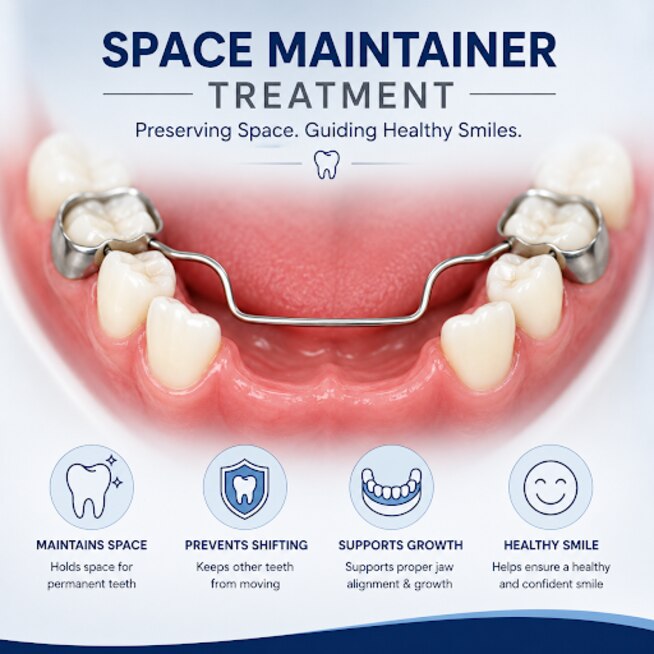
The right appliance depends on the missing tooth, the number of teeth lost, the eruption stage, and whether the supporting teeth are strong enough to hold it. A band-and-loop space maintainer suits many unilateral primary molar losses, but it controls only a limited part of the arch and does not restore chewing across the gap.
| Design | Best fit | Main limitation or requirement |
|---|---|---|
| Band-and-loop space maintainer | One missing primary molar on one side | Preserves local space but does not replace the missing chewing surface |
| Crown-and-loop appliance | A missing molar beside a tooth that already needs a stainless-steel crown | Uses a crowned supporting tooth rather than a separate band |
| Distal shoe space maintainer | Primary second molar lost before the first permanent molar erupts | Extends beneath the gum, so it needs clinical and radiographic review and is commonly converted or replaced after eruption |
| Lower lingual holding arch or upper transpalatal appliance | Bilateral or multiple-tooth loss | Requires permanent molars to be sufficiently erupted for stable support |
| Removable upper or lower maintainer | Several missing teeth when the child can manage the appliance | Works only when the child wears it as instructed |
Fixed designs avoid daily removal, but bands, crowns, wires, and soldered joints make cleaning harder. Loose cement, solder fracture, or distortion can make the appliance ineffective or injure the mouth. No single design is best for every child; the choice must match the arch, eruption stage, hygiene, and cooperation of the child.
What happens when a child is fitted with a space maintainer?
At a space maintainer fitting, the dentist checks and prepares the supporting tooth, then takes a dental impression or digital scan. The appliance is made or selected and, for a fixed design, attached with dental cement.
| Type | What happens at fitting | First adjustment |
|---|---|---|
| Fixed space maintainers | Bands, crowns, wires, or soldered joints stay attached to the supporting teeth after cementing. | The child may feel pressure, vibration, or temporary gum tenderness, followed by several days of adapting to a new shape. |
| Removable space maintainers | The dentist inserts the appliance and shows the child or parent how to put it in and take it out. | Speech and chewing can feel different; practice clear speaking and choose softer foods briefly. |
Brushing must reach around bands, crowns, wires, and soldered joints. A floss threader, interdental brush, or other cleaning aid may be needed because trapped plaque can cause gum inflammation, decay, or cement failure.
Contact the dentist promptly for pain, rubbing, persistent speech difficulty, a loose appliance, or a broken wire. Waiting for the next routine visit can allow tooth movement or soft-tissue injury to worsen.
Follow-up checks track the permanent tooth’s eruption, gum irritation, unwanted movement, and appliance condition. The dentist may adjust or remove the maintainer when the successor tooth begins erupting or the design no longer fits the changing mouth.
How do you protect the appliance and know when treatment is complete?
A fixed space maintainer needs daily care and periodic decisions, not just a successful fitting. Bands, crowns, wires, and soldered joints create plaque-retentive areas that can cause decalcification, caries, gingival inflammation, cement failure, solder fracture, soft-tissue injury, or interference with eruption.
1. Supervise brushing around every band, crown, wire, and joint. Use a floss threader or the cleaning aid your dentist recommends, and check that food is not packed beneath the appliance.
2. Limit frequent sugary foods and drinks, especially between meals. Repeated sugar exposure around a fixed appliance can produce decay that creates a bigger problem than the original lost space.
3. Inspect the appliance each day for looseness, bending, a sharp edge, or a changed position. Pain, rubbing, swelling, a broken wire, or difficulty chewing requires prompt review rather than waiting for the next appointment.
4. Attend scheduled reviews so the dentist can check cement, gums, tooth movement, hygiene, and the permanent successor’s eruption. Do not leave a maintainer until adolescence without review.
Knowing when to remove a space maintainer depends on examination. Removal is appropriate when the permanent successor is erupting into the preserved space, or when the appliance no longer suits the tooth position, bite, or eruption path.
For a child in Hadapsar, a paediatric dentist in Hadapsar, Pune such as Dr Rohini Lahane can assess the loss, eruption stage, bite, hygiene, and appliance condition before recommending continued treatment. An individualized examination is safer than requesting an appliance solely because a baby tooth was extracted.
Related service
Pediatric / Kids Dental Care by Dr. Rohini Lahane in Hadapsar, Pune Dr. Rohini Lahane (BDS, MDS) provides Space Maintainer Treatment to help preserve the space left by a... View service → |
Frequently asked questions
Which early baby-tooth losses are most likely to threaten space?
Premature loss of a primary molar poses the greatest spacing risk, especially loss of a second primary molar before the first permanent molar erupts. Nearby teeth can tip or drift into the gap.
How does a dentist decide whether a space maintainer is needed?
The dentist examines the missing tooth, the child’s age, the eruption stage of permanent teeth, the space available, the bite, and whether neighbouring teeth have already moved. Dental X-rays can show the position and development of the unerupted tooth.
Which space maintainer fits the tooth and the child?
A dentist chooses between fixed appliances, such as a band-and-loop or distal shoe, and removable appliances based on the missing tooth, eruption stage, number of teeth lost, oral hygiene, and the child’s ability to follow instructions.
What happens when a child is fitted with a space maintainer?
The dentist checks the teeth, selects or makes the appliance, fits it without blocking the developing permanent tooth, and explains cleaning and food precautions. Follow-up visits check comfort, fit, hygiene, and tooth movement.
How do you protect the appliance and know when treatment is complete?
Brush carefully around the appliance, avoid sticky or hard foods that can loosen or bend it, and report pain, breakage, or looseness promptly. The dentist removes it when the permanent tooth is ready to erupt or the space is no longer at risk.