A missing adult tooth does not automatically mean that an implant is suitable or that treatment must begin immediately. By the end, you will be able to identify the clinical situations that support implant consideration, compare the main alternatives, recognise reasons to delay, and prepare useful questions for a dental consultation.
Key takeaways
- Implants can replace one tooth, several teeth, or a full arch.
- Compare implants with bridges, partial dentures, and leaving the gap.
- Bone loss, gum disease, smoking, and uncontrolled diabetes can delay placement.
- Healing time and bone grafting affect the treatment schedule.
Which patterns of tooth loss can implants address?
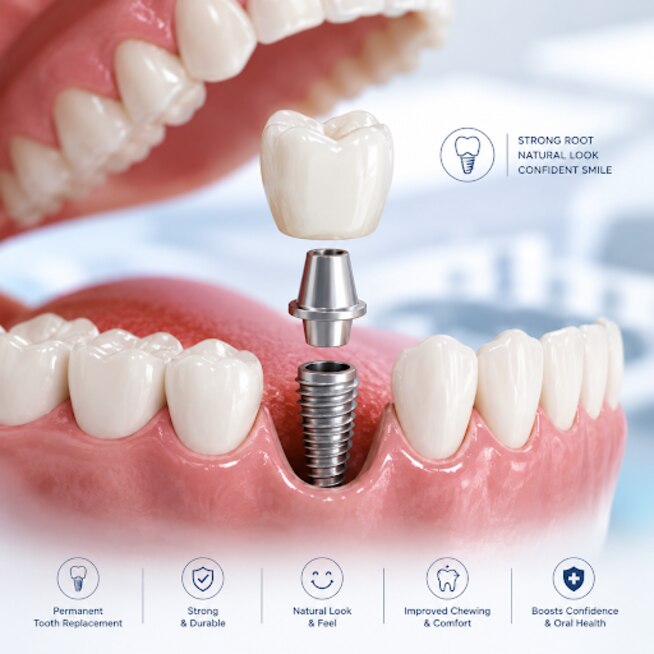
An implant-supported restoration is worth discussing when the missing tooth or teeth leave a useful space, the bite can support replacement, and the jaw has enough healthy bone for stable placement. The implant is an artificial root; it supports a separate visible crown, bridge, or denture.
| Pattern of tooth loss | Possible implant-supported restoration | Positioning issue |
|---|---|---|
| One missing tooth | One implant-supported crown | Replaces the tooth without preparing neighbouring teeth for a conventional bridge |
| Several adjacent missing teeth | Two or more implants supporting a bridge | Implant number and spacing depend on the gap length and biting forces |
| Complete tooth loss | Several implants supporting a fixed bridge, or an implant-supported denture | Implants distribute chewing forces across an otherwise toothless jaw |
One missing tooth is not automatically an implant case. A conventional fixed bridge, orthodontic space closure, or leaving the space untreated can fit better when the neighbouring teeth, bite, bone, age, or treatment goals point elsewhere.
Several adjacent missing teeth can often be restored with fewer implants than the number of teeth replaced, because a bridge spans the gap. A removable partial denture remains another option when surgery, cost, cleaning demands, or available bone make implants unsuitable.
Complete tooth loss does not mean every tooth needs its own implant. An implant-supported denture can improve retention, while a fixed implant bridge requires adequate support and more complex cleaning.
A recently extracted tooth is different from a permanently healed gap: the socket and bone may still be changing. Placement may occur immediately in selected cases or after healing, depending on infection, bone, and soft-tissue conditions. Growth, gum disease, smoking, poor hygiene, and healing problems can delay or rule out treatment.
What should you compare with an implant before filling the gap?
Compare the implant with the time, surgery, maintenance, and effect on neighbouring teeth required by each alternative. An implant is an artificial root placed in bone; it still needs a separate crown, bridge, or denture to replace the visible tooth.
| Option | What it means | Main advantages and trade-offs |
|---|---|---|
| Dental implant | A surgically placed root that supports a crown after healing | Does not require cutting adjacent teeth, but involves surgery, several months of treatment, and sufficient bone and healthy gums |
| Conventional fixed dental bridge | A replacement tooth joined to crowns on adjacent teeth | Usually avoids implant surgery and is fixed in place, but healthy supporting teeth must be reshaped and carry extra load |
| Removable partial denture | A removable replacement tooth or teeth held by a framework or clasps | Often replaces several teeth without surgery, but it can move, cover gum areas, require removal for cleaning, and place force on remaining teeth |
| Orthodontic space closure | Braces or aligners move neighbouring teeth into the gap | Can avoid a prosthetic tooth and implant, but needs suitable tooth positions, bite, roots, and treatment time |
| Leaving the space untreated | No replacement is placed | Avoids treatment now, but adjacent teeth can drift, the opposing tooth can over-erupt, and the bone ridge can shrink |
Your bite, the tooth’s position, cleaning ability, and the condition of neighbouring teeth determine which trade-off matters most. Orthodontic space closure suits some gaps, not every missing tooth. Leaving a space untreated can remain reasonable when movement will not impair function or appearance, but review the gap rather than assuming it is harmless.
Rescue untreated decay or uncontrolled gum disease before choosing an implant.
Which findings can rule out or delay implant placement?
Uncontrolled gum disease must be treated before implant surgery. The bacteria and inflammation that damage natural teeth can also infect the tissues around an implant, causing peri-implant disease and bone loss. A dentist should also check for untreated decay, broken teeth, and infection elsewhere in the mouth.
| Finding | What needs to happen | Why placement may wait |
|---|---|---|
| Uncontrolled gum disease | Complete periodontal treatment and establish stable gum health | Inflammation raises the risk of peri-implant disease |
| Untreated decay or infection | Restore decayed teeth and treat abscesses before surgery | Bacteria can compromise healing and future maintenance |
| Poor oral hygiene | Improve daily brushing, interdental cleaning, and plaque control | Persistent plaque can inflame tissues around the implant |
| Heavy smoking | Stop before surgery and avoid smoking during healing | Smoking impairs healing and increases implant failure risk |
| Medical conditions or medicines affecting healing | Review diabetes control, immune conditions, and medicines with the dentist and physician | Healing and infection risk may require medical optimisation |
| Insufficient bone or an infected extraction socket | Allow healing or consider grafting, ridge augmentation, or a sinus lift | The implant needs stable bone and suitable soft tissue |
Insufficient bone does not automatically rule out treatment, but grafting adds surgery, healing time, cost, and uncertainty. An implant placed immediately after extraction is also not suitable for every socket: damaged socket walls, infection, poor gum condition, or inability to achieve primary stability can make delayed placement safer.
How are bone, age, healing, and treatment timing assessed?
A clinical examination determines whether the site is healthy enough for implant planning. Your dentist checks gum inflammation, periodontal pockets, nearby teeth, bite forces, socket shape, soft-tissue thickness, and signs of bone loss. Medical history, smoking, diabetes control, and medicines that affect healing also influence timing.
Dental X-rays show the roots, infection, and general bone height. If two-dimensional images do not show enough detail, a 3D cone-beam CT can map bone width, the inferior dental nerve, adjacent roots, and the maxillary sinus. Because it uses radiation, it should be ordered when the examination shows that three-dimensional information will change the plan.
- Now: Placement may follow when the socket has suitable walls, healthy gum tissue, no active infection, enough bone for primary stability, and a predictable position for the final crown.
- After healing: A recently extracted socket may need time for soft tissue and bone to settle before imaging and placement. Immediate placement is not suitable when infection, damaged socket walls, poor tissue, or inadequate stability is present.
- After additional treatment: Bone grafting, ridge augmentation, or a sinus lift may rebuild the site before placement. These procedures add surgery, healing time, cost, and uncertainty.
Age matters mainly because jaw growth must be complete; chronological age alone does not set an upper limit. Poorly controlled diabetes, heavy smoking, or active gum disease can delay healing until treatment and medical coordination improve the outlook.
What happens during treatment and after the crown is fitted?
A dental implant has three parts: the titanium implant fixture sits in the jawbone, the abutment connects it to the restoration, and the visible crown replaces the tooth you see. The fixture does not function as the tooth on its own.
Treatment usually follows these stages:
- The dentist plans surgery, treats active gum disease or decay, and removes the tooth if it remains.
- The fixture is placed, with a temporary tooth provided when appearance or chewing requires it.
- Osseointegration, when bone bonds to the fixture, commonly takes several months. Bone grafting adds further healing time.
- The abutment and visible crown are fitted after stability is confirmed. Immediate placement after extraction is safe only when the socket and surrounding tissues provide adequate support.
Clean the crown, abutment, and gumline every day with a toothbrush and interdental brush or floss designed for implants. Attend maintenance visits so plaque-related peri-implant mucositis is found before it progresses to peri-implantitis and bone loss. Do not smoke during healing, and ask about diabetes control before surgery.
Contact your dentist promptly for increasing pain, swelling, pus, bleeding, fever, a loose crown, or movement of the implant. Ask Dr Rohini Lahane which fixture position, healing interval, temporary option, cleaning tools, and review schedule fit your case.
Related service
Adult Dental Care Dr. Rohini Lahane (BDS, MDS) provides advanced dental implant treatment to restore missing teeth with natural-looking, long-lasting results. View service → |
Frequently asked questions
Which patterns of tooth loss can dental implants address?
Implants can support a single crown, an implant bridge for several missing teeth, or a denture for extensive tooth loss when the space and bite are suitable.
What should you compare with an implant before filling the gap?
Compare an implant with a conventional bridge, removable partial denture, or no replacement, considering stability, tooth preparation, maintenance, treatment time, and cost.
Which findings can rule out or delay implant placement?
Active gum disease, inadequate bone, untreated decay, poor oral hygiene, heavy smoking, and uncontrolled medical conditions can require treatment before placement or make an implant unsuitable.
How are bone, age, healing, and treatment timing assessed?
A dental examination, bite assessment, dental X-rays, and sometimes a cone-beam CT scan help assess bone volume, growth, healing risks, and the timing of placement.
What happens during treatment and after the crown is fitted?
The implant is placed in the jaw, allowed to integrate with bone, connected to an abutment, and restored with a crown. After fitting, clean around it daily and attend maintenance visits.