
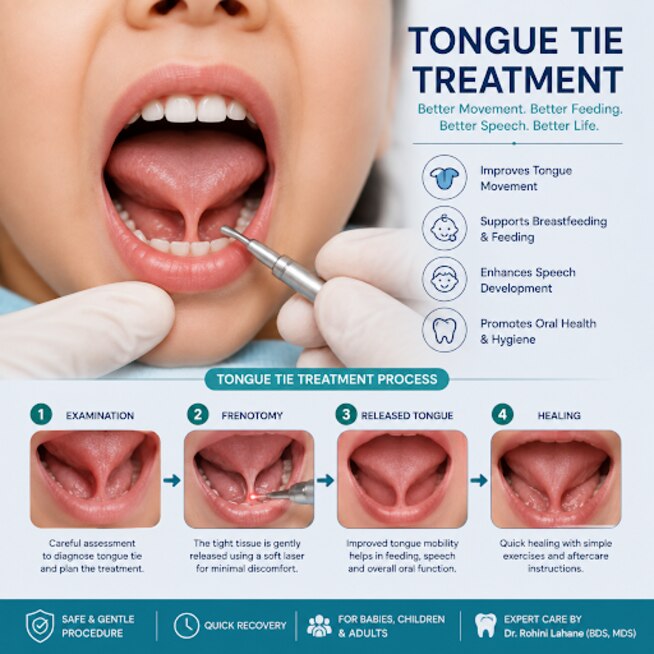
A visible band beneath a child’s tongue is not, by itself, proof of a tongue tie or a reason for surgery. The useful question is whether the lingual frenulum restricts movement enough to affect feeding, speech, chewing, oral hygiene, or comfort; by the end, you can identify observations worth discussing with a clinician and understand how evaluation guides treatment.
Key takeaways
- A short-looking frenulum alone does not prove tongue tie or require treatment.
- Feeding, speech, tongue movement, and oral hygiene signs vary with age.
- Clinicians assess function and rule out other causes before recommending treatment.
- Ask about observation, therapy, frenotomy, frenectomy, aftercare, and expected benefits.
What the Lingual Frenulum Does—and Which Signs Matter
The lingual frenulum is the band of tissue under the tongue that connects it to the floor of the mouth. If it is unusually short, thick, or tight, it can limit lifting, protruding, or side-to-side movement. A low attachment or short-looking band alone does not diagnose tongue tie or prove that treatment is needed.
Ask for a dental evaluation when you observe these tongue tie signs:
- The child cannot lift the tongue towards the upper teeth or palate.
- The tongue cannot sweep food from the cheeks, teeth, or floor of the mouth.
- The tongue tip looks heart-shaped when the child sticks it out.
- Pulling under the tongue causes pain, sores, or repeated trauma.
- Persistent open-mouth posture occurs with hygiene, chewing, feeding, or speech concerns.
- Speech sounds remain unclear and restricted tongue movement appears to be involved.
| Situation | What to check | Who may help |
|---|---|---|
| Newborn feeding difficulty | Latch, milk transfer, clicking, fatigue, maternal nipple pain, and weight gain; do not blame every feeding problem on tongue tie | Paediatrician and lactation consultant |
| Older child with oral problems | Tongue elevation, side-to-side movement, food clearance, brushing difficulty, and painful gum pulling | Dentist |
| Speech concern | Whether tongue restriction affects specific sounds, after checking hearing and language development | Speech-language pathologist, dentist |
Many children have normal variation and normal speech despite a visible frenulum. A dental evaluation identifies functional restriction; it does not automatically lead to a procedure.
How Possible Tongue Restriction Looks Different at Each Age
A newborn needs prompt feeding assessment when restricted tongue movement is paired with persistent breastfeeding difficulty. Look for painful latch, clicking, long or tiring feeds, poor milk transfer, or inadequate weight gain.
A paediatrician and lactation professional should assess feeding before anyone recommends frenotomy; nipple pain may improve after treatment, but long-term feeding benefits are less certain.
- Toddlers may show difficulty managing textured foods, chewing, swallowing, or moving food from the cheeks. Food left under the tongue, fatigue during meals, or frequent coughing deserves review, but reflux, oral-motor development, and swallowing problems can produce similar signs. A dentist or paediatrician can direct the next assessment.
- School-age children may struggle to lift the tongue towards the upper teeth, move it side to side, clean food from teeth, or maintain oral hygiene. A heart-shaped tongue tip, painful pulling under the tongue, or persistent open-mouth posture supports evaluation; appearance alone does not prove clinically significant restriction.
- Teenagers need an assessment based on function, not a short-looking frenulum. Ask for review if tongue movement causes recurrent injury, trouble clearing food, speech sounds and tongue tie appear plausibly connected, or the tongue cannot rest against the palate.
Speech-language and hearing evaluations should come before surgery for speech concerns, because many children speak normally and procedures do not reliably prevent later problems.
How Clinicians Separate Tongue Tie from Other Feeding and Oral Problems
A visible or low-attaching frenulum is a finding, not a surgical diagnosis. A proper tongue-tie assessment tests whether restricted movement is causing a specific problem and checks other explanations before anyone recommends a procedure.
1. A clinician observes the tongue at rest and during lifting toward the upper teeth, side-to-side movement, protrusion, and tongue-tip shape. A heart-shaped tip or prominent tissue supports further examination but does not prove that the frenulum is responsible.
2. For an infant, the assessment includes positioning, latch, milk transfer, clicking, maternal nipple pain, fatigue, weight gain, milk supply, prematurity, and oral-motor coordination. A lactation consultant and paediatrician can identify poor attachment, reflux-like symptoms, neurological problems, or anatomical issues that surgery would not correct.
3. For an older child, the clinician checks chewing, swallowing, speech movements, tongue-to-palate contact, food trapped under the tongue, persistent open-mouth posture, and the ability to clean the teeth. A dentist or paediatric dentist may examine painful pulling on the lingual gum and related oral-hygiene problems.
4. Speech concerns require a speech-language pathologist and, when appropriate, a hearing evaluation before attributing sounds to tongue restriction. Many children with ankyloglossia speak normally, and evidence that surgery prevents future speech problems is limited.
The team also reviews bleeding disorders, medicines, previous oral procedures, pain, infection risk, and the possibility of scarring, feeding refusal, or reattachment. The findings should show a functional problem with a plausible link to the frenulum—not appearance alone.
Observation, Therapy, Frenotomy, or Frenectomy: Comparing the Choices
A short-looking frenulum does not automatically need tongue tie treatment. Monitor when the child eats comfortably, clears food, maintains oral hygiene, and moves the tongue well enough for daily function. Do not release tissue solely to prevent future spacing, bite changes, sleep-disordered breathing, or jaw-growth problems.
Functional therapy fits children whose movement or habits cause difficulty but do not require immediate tissue release. A speech-language pathologist can assess sounds, while exercises or feeding support may address coordination; check hearing before linking speech difficulty to tongue restriction. Therapy cannot lengthen a truly restrictive frenulum, so persistent mechanical limitation needs dental review.
| Option | What it means | When it applies |
|---|---|---|
| Observation | Track feeding, speech, chewing, cleaning, and tongue movement | No clear functional problem or symptoms are improving |
| Functional therapy | Feeding, oral-motor, or speech support based on the identified difficulty | Function is affected but tissue release is not yet justified |
| Frenotomy | A small incision that releases the frenulum | A defined restriction needs a limited release |
| Frenectomy | Removal or excision of more frenulum tissue | The tissue is thick, extensive, or likely to remain restrictive after a simple release |
A frenectomy is not automatically better than a frenotomy. Age, anatomy, symptoms, and examination findings determine the choice; a frenuloplasty is a more extensive release that may reposition tissue and require sutures. Laser does not guarantee better function than scissors or a scalpel.
Dr Rohini Lahane can help families in Hadapsar separate a visible attachment from a restriction that genuinely warrants a procedure.
Related service
Pediatric / Kids Dental Care by Dr. Rohini Lahane in Hadapsar, Pune Dr. Rohini Lahane (BDS, MDS) provides expert diagnosis and treatment for Tongue Tie (Ankyloglossia) in... View service → |
Questions to Ask Before Agreeing to a Procedure
Before you agree to treatment, ask for a specific goal and a plan to measure whether tongue function improves. A dental evaluation should consider movement and symptoms, not the frenulum’s appearance alone.
- What problem is the procedure meant to improve? Ask whether the concern involves feeding, chewing, oral hygiene, painful pulling, or speech, and whether a paediatrician, speech-language pathologist, lactation consultant, or hearing evaluation is needed first.
- What benefit is realistic, and what will it not fix? Tongue-tie surgery does not guarantee clearer speech, better feeding, or prevention of future problems. Many children have normal speech despite ankyloglossia.
- Which technique do you recommend, and why? Ask whether this is a frenotomy or frenectomy, whether scissors or a laser frenotomy will be used, what pain control is planned, and how the child will be kept still.
- What are the tongue-tie procedure risks for this child? Ask about bleeding, infection, pain, scarring, injury to nearby structures, reattachment, feeding refusal, and oral aversion. Discuss bleeding disorders, medicines, allergies, and other medical conditions before scheduling.
- What does post-procedure care involve? Get written instructions for feeding, pain relief, cleaning, warning signs, and follow-up. Ask whether exercises are recommended; routine forceful wound stretching lacks strong evidence and can distress a child or trigger feeding aversion.
Do not accept “the frenulum looks tight” as the complete explanation. Ask what finding makes treatment more useful than observation or therapy.
Frequently asked questions
What signs of tongue restriction matter in children?
Signs depend on age and function. Clinicians look at feeding difficulty, limited tongue movement, speech concerns, trouble clearing food, and oral hygiene problems rather than appearance alone.
How does possible tongue tie look different at each age?
Babies may have difficulty latching, staying attached, or transferring milk. Older children may show restricted tongue movement, speech concerns, difficulty eating certain foods, or trouble cleaning the mouth.
How do clinicians distinguish tongue tie from other feeding and oral problems?
They examine tongue movement and frenulum attachment, ask about feeding or speech history, and consider other causes such as positioning, oral-motor difficulties, dental problems, or speech disorders.
What are the options for treating tongue tie?
Depending on symptoms and functional impact, options include observation, feeding or speech therapy, frenotomy, or frenectomy. The choice depends on the child’s assessment and expected benefit.
What should parents ask before agreeing to frenotomy or frenectomy?
Ask what functional problem the procedure is intended to address, which alternatives were considered, who will perform it, what aftercare involves, and how improvement will be assessed.