

Severe tooth pain has a way of disrupting everything. Sleeping becomes difficult, chewing may hurt, and even a cup of tea can trigger intense sensitivity.
When the dental pulp inside a tooth becomes severely inflamed or infected, root canal treatment may be required. Patients searching for an RCT specialist in Hadapsar should focus first on accurate diagnosis because not every painful tooth needs root canal treatment.
First Find Out Why the Tooth Hurts
Tooth pain can arise from several conditions, including deep decay, a cracked tooth, gum problems, sensitivity, trauma, or infection.
Before RCT is started, the affected tooth should be assessed clinically. Dental X-rays may also be required to evaluate roots, surrounding bone, decay, or other findings that cannot be fully assessed visually.
The objective is to determine whether the pulp is affected and whether the tooth can be predictably restored.
What Should You Ask Before Root Canal Treatment?
Patients do not need to understand technical endodontic terminology, but a few practical questions can make treatment planning clearer:
- Why does this tooth need RCT?
- Is the tooth restorable?
- Are there alternatives?
- How many appointments may be required?
- Will the tooth need a crown?
- What should I expect after treatment?
- What happens if treatment is delayed?
Clear answers help patients understand both the immediate procedure and the longer-term restoration of the tooth.
What Happens During RCT?
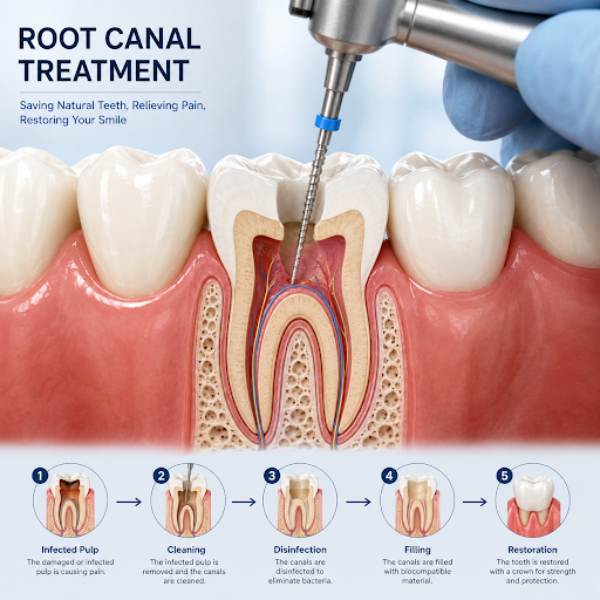
Root canal treatment is performed to remove affected tissue from inside the tooth.
After suitable anaesthesia, the internal root canal system is accessed, cleaned, shaped, disinfected, and sealed. The tooth then requires an appropriate restoration.
For some back teeth and structurally weakened teeth, a crown may be advised to provide additional protection after RCT. The recommendation depends on how much healthy tooth structure remains and the forces placed on that tooth.
Do Antibiotics Replace Root Canal Treatment?
Antibiotics are not a substitute for removing an infected pulp when root canal treatment is clinically required.
They may be prescribed in particular situations based on the dentist’s assessment, especially when infection has specific features. Taking medication without treating the source of the dental problem can allow symptoms to return.
Patients experiencing persistent tooth pain or swelling can consult Dr Rohini Lahane in Hadapsar, Pune, for evaluation of the affected tooth and discussion of the appropriate treatment approach.
Do Not Judge Treatment Only by Pain Relief
The purpose of successful root canal care extends beyond making the tooth stop hurting.
The canals need to be properly treated, and the tooth needs an appropriate final restoration. Follow-up is also important where recommended.
When choosing an RCT specialist in Hadapsar, consider diagnosis, treatment explanation, restorative planning, hygiene standards, and follow-up care. Addressing a persistently painful tooth at the right stage may provide an opportunity to retain it rather than allowing damage to progress further.